Ancient Rome gave the world some of history’s most powerful names. From emperors who ruled continents to gladiators who fought for glory, Roman names still feel bold and timeless today.
If you’re naming a character, a baby, or a gaming avatar, this guide gives you real Roman naming rules plus hundreds of name ideas. No fluff, just names and facts you can actually use.
The Tria Nomina: How Ancient Roman Naming Actually Worked
Roman citizens didn’t use just one name. They used a system called the tria nomina, meaning “three names.”
This system had three parts, and each part told people something different about you.
| Name Part | What It Means | Example |
| Praenomen | Personal first name | Gaius |
| Nomen | Family clan name | Julius |
| Cognomen | Nickname or branch name | Caesar |
Praenomen was your personal name, similar to a first name today. Romans only used about 18 common praenomens for men.
Nomen showed which family clan (gens) you belonged to. It was the most important part of a Roman name.
Cognomen started as a nickname but later became hereditary. It marked a specific family branch within a larger clan.
Women often had a simpler system. They usually took the feminine form of their father’s nomen, like Julia from Julius.
Understanding this three-part structure is the key to creating names that actually sound Roman, not just names with a Latin flavor.
Roman Male Names (and the “-us/-ius” Naming Rule)
Roman male names almost always end in -us or -ius. This wasn’t random. It followed strict Latin grammar rules for masculine nouns.
Names ending in -ius usually belonged to a gens or clan, like Julius or Claudius. Names ending in simple -us were often personal or standalone names.
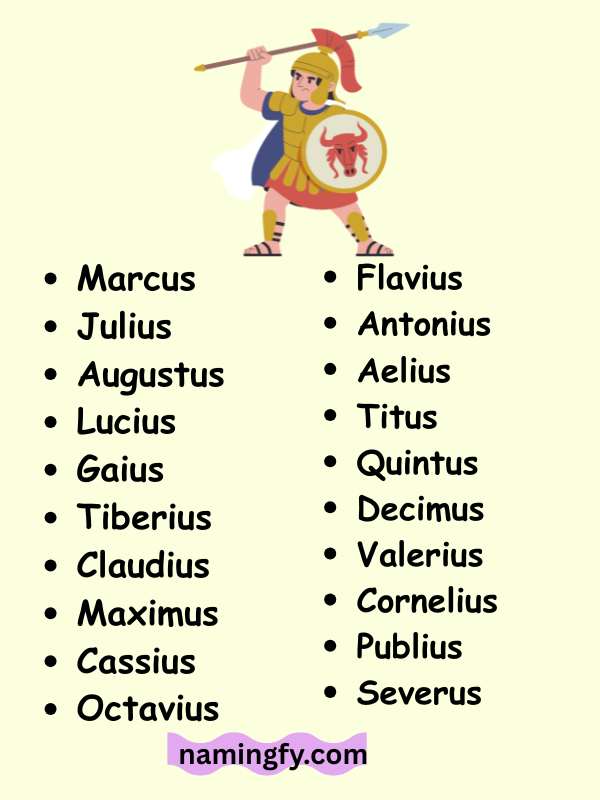
Here are popular Roman male names:
- Marcus
- Gaius
- Lucius
- Titus
- Quintus
- Marius
- Julius
- Claudius
- Antonius
- Brutus
- Cassius
- Flavius
- Octavius
- Servius
- Tiberius
Featured Answer: Most Roman male names end in “-us” or “-ius” because Latin grammar marks masculine nouns this way. This pattern still influences modern names like Marcus and Julius.
Roman Female Names (and the “-a/-ia” Naming Rule)
Roman female names followed the opposite pattern. They typically ended in -a or -ia, matching feminine Latin grammar.
Most women simply took the feminine version of their father’s family name. So a daughter of Julius became Julia.
Popular Roman female names include:
- Julia
- Livia
- Claudia
- Antonia
- Valeria
- Octavia
- Flavia
- Cornelia
- Aurelia
- Domitia
- Marcella
- Portia
- Drusilla
- Lucia
- Camilla
If a family had more than one daughter, Romans added numbers like Secunda (second) or Tertia (third) to tell them apart.
Ancient and Old Roman Names
Ancient Roman names came from three main sources: Latin roots, Etruscan influence, and later Christian tradition.
Early Roman names were shorter and simpler. Over centuries, they grew into full three-part citizen names.
Here are classic ancient and old Roman names still recognized today:
- Numerius
- Appius
- Manius
- Spurius
- Aulus
- Decimus
- Vibius
- Sextus
- Publius
- Gnaeus
Many old Roman praenomens were also used as abbreviations on inscriptions, like “M.” for Marcus or “C.” for Gaius. This shows how standardized Roman naming really was.
Full Roman Names (Praenomen, Nomen & Cognomen Combined)
A full Roman name combines all three parts of the tria nomina into one identity.
For example: Gaius Julius Caesar breaks down as praenomen (Gaius), nomen (Julius), and cognomen (Caesar).
Here are sample full Roman names you can use directly:
- Marcus Antonius Felix
- Lucius Cornelius Sulla
- Titus Flavius Vespasianus
- Gaius Julius Maximus
- Quintus Fabius Maximus
- Publius Aelius Hadrianus
- Marcus Aurelius Severus
This structure works well for fiction, games, and role-play characters who need historical accuracy.
Common Roman Last Names (Cognomen)
Cognomens often described a physical trait, personality, or achievement. Some sound funny today but were serious identifiers back then.
Common Roman cognomens include:
- Caesar (hairy)
- Rufus (red-haired)
- Magnus (great)
- Longus (tall)
- Crassus (fat)
- Brutus (heavy or dull)
- Naso (big nose)
- Cicero (chickpea)
- Felix (lucky)
- Severus (strict)
Cognomens later became fixed family surnames, passed down like modern last names.
Roman First Names (Praenomen)
Praenomens were personal names given at birth, usually within the first nine days for boys and eight days for girls.
Romans reused a small pool of about 18 male praenomens repeatedly across generations.
Common Roman first names (praenomen) list:
- Aulus
- Gaius
- Gnaeus
- Lucius
- Marcus
- Publius
- Quintus
- Servius
- Sextus
- Titus
Because so few praenomens existed, the nomen and cognomen did most of the work identifying a person.
Best Fantasy Roman Names
Fantasy writers love Roman names because they sound powerful without needing translation. They fit warriors, senators, and mystical rulers equally well.
Best fantasy Roman name ideas:
- Draconius
- Valerian Nox
- Magnus Ferrum
- Aurelia Umbra
- Lucian Ignis
- Servius Umbrarum
- Titus Solaris
- Marcella Tempest
- Octavian Shade
- Cassia Draco
These names blend authentic Roman roots with fantasy-style twists, perfect for games and novels.
Cool Roman Name Ideas
Sometimes you just want a name that sounds strong and stylish, without deep historical meaning.
Cool Roman name ideas:
- Maximus
- Cassius
- Atticus
- Severin
- Octavian
- Darius Romanus
- Valerius
- Lucan
- Cornelius
- Marius Rex
These names work great for usernames, characters, or even pets with attitude.
Catchy Unisex Roman Name Ideas
Not every Roman-style name has to follow strict gender rules. Some sound great for any gender today.
Catchy unisex Roman name ideas:
- Val (short for Valeria/Valerius)
- Cass (from Cassius/Cassia)
- Auri (from Aurelius/Aurelia)
- Flavia/Flavian
- Marcelli
- Livian
- Octavi
- Corvin
- Sabin
- Tullia/Tullius
These shortened forms feel modern while keeping their Latin roots visible.
Funny Roman Names
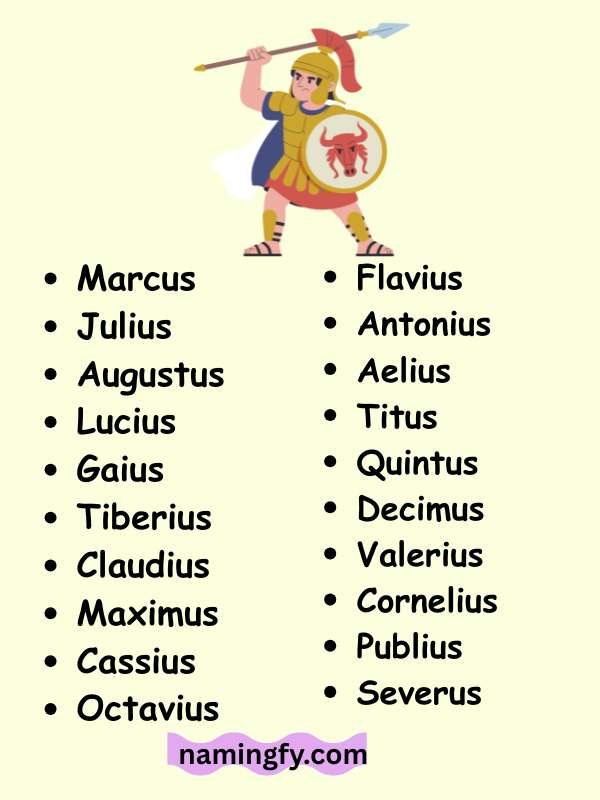
Romans had a sense of humor too. Many cognomens were literally insults or jokes that stuck for life.
Funny Roman names and their meanings:
- Naso – “big nose”
- Crassus – “fat”
- Caligula – “little boots”
- Strabo – “cross-eyed”
- Balbus – “stammerer”
- Paulus – “small”
- Scaeva – “left-handed”
- Vatia – “bow-legged”
Imagine being remembered forever in history books simply as “Big Nose.” Romans didn’t hold back.
Modern Roman Names and Roman-Style Baby Names
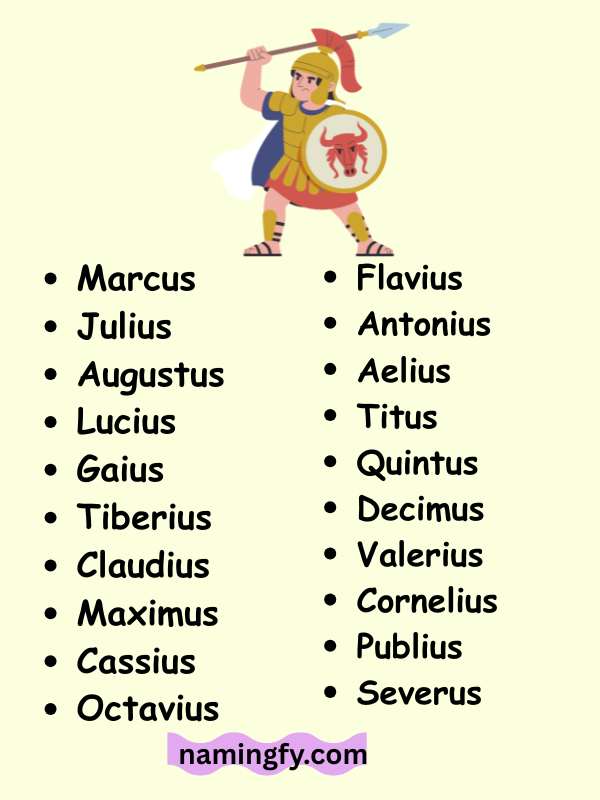
Many Roman names never went out of style. They quietly survived through centuries and still top baby name charts today.
Modern Roman-style baby names for boys:
- Julian
- Marcus
- Lucas
- Maximus
- Antony
- Felix
- Adrian
- Silas
Modern Roman-style baby names for girls:
- Julia
- Livia
- Aurora
- Camilla
- Sabina
- Claudia
- Flora
- Antonia
These names feel classic, easy to pronounce, and instantly recognizable across cultures.
Roman Gods and Goddesses Names
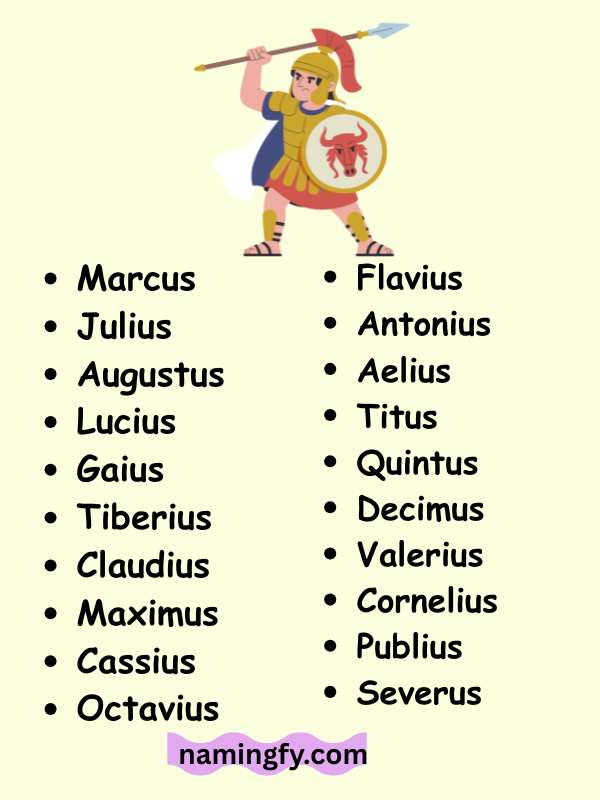
Roman religion shaped daily life, and gods often lent their names to Roman citizens too.
| Roman God/Goddess | Domain |
| Jupiter | King of gods, sky |
| Juno | Marriage, women |
| Mars | War |
| Venus | Love, beauty |
| Minerva | Wisdom, strategy |
| Neptune | Sea |
| Diana | Hunting, moon |
| Vulcan | Fire, forge |
| Ceres | Harvest |
| Bacchus | Wine, celebration |
Names like Diana, Victoria, and Fortuna are still used today, taken directly from Roman deities.
Greek and Roman Mythology Names
Rome borrowed heavily from Greek mythology, simply renaming Greek gods with Latin names.
Here’s how Greek and Roman mythology names connect:
| Greek Name | Roman Equivalent |
| Zeus | Jupiter |
| Hera | Juno |
| Ares | Mars |
| Aphrodite | Venus |
| Athena | Minerva |
| Poseidon | Neptune |
| Artemis | Diana |
| Hades | Pluto |
This overlap is why so many mythology-inspired names feel familiar in both cultures. Writers often mix both traditions to build richer fantasy worlds.
Roman Emperor Names
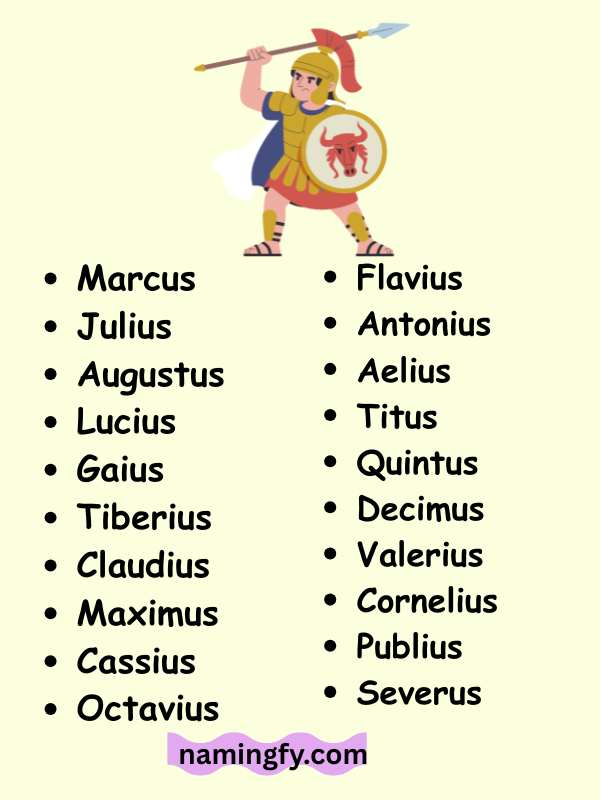
Roman emperors ruled for over 400 years, and their names became symbols of power itself.
Famous Roman emperor names:
- Augustus
- Tiberius
- Caligula
- Claudius
- Nero
- Vespasian
- Titus
- Domitian
- Trajan
- Hadrian
- Marcus Aurelius
- Constantine
Featured Answer: Augustus was Rome’s first official emperor, ruling from 27 BC. His name became a title itself, used by later emperors as a mark of supreme authority.
Roman Gladiator Names
Gladiators fought under stage names designed to sound fierce in the arena. These names built fear and fame before the fight even began.
Roman gladiator name ideas:
- Spartacus
- Crixus
- Flamma
- Priscus
- Verus
- Commodus
- Tigris
- Aquila
- Ferox
- Sanguinarius
Gladiator names often referenced animals, weapons, or violent traits to intimidate opponents and thrill crowds. If you’re building a warrior character list, this knight names guide pairs well with Roman gladiator naming styles for medieval-fantasy crossovers.
Traditional and Magical Roman Names
Traditional names stuck close to historical Latin roots, while magical versions add mystery for fantasy settings.
Traditional and magical Roman name ideas:
- Merula (blackbird, mystical)
- Umbra (shadow)
- Lux (light)
- Fatum (fate)
- Nocturna (night)
- Stellaris (star-like)
- Draconis (dragon)
- Solis (of the sun)
These names blend real Latin vocabulary with imaginative meaning, great for tarot-style or mystical characters.
Powerful Roman Names and Their Meanings
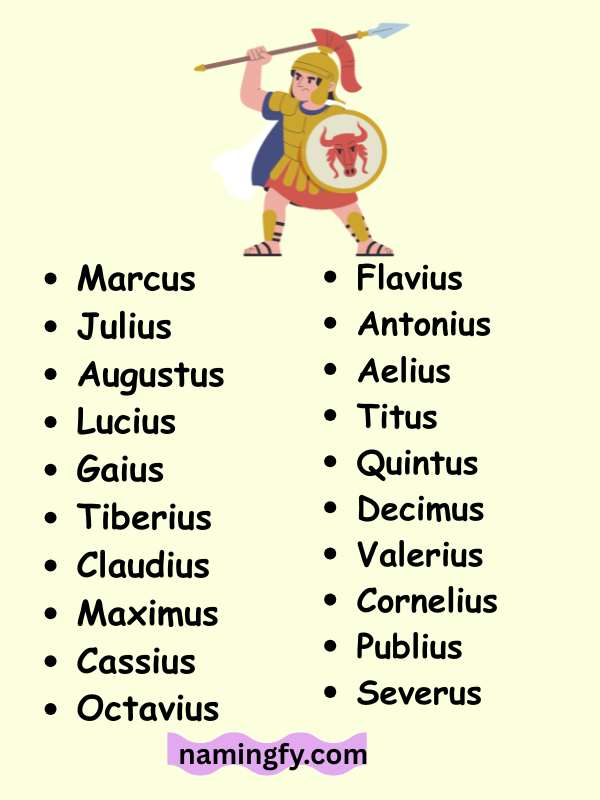
Some Roman names carry meanings tied directly to strength, victory, or leadership.
| Name | Meaning |
| Maximus | Greatest |
| Victor | Conqueror |
| Rex | King |
| Fortis | Strong |
| Regulus | Little king |
| Imperator | Commander |
| Valens | Powerful |
| Dominus | Master |
These meanings make them popular choices for characters who need to feel commanding from the first mention.
Popular and Historical Roman Names
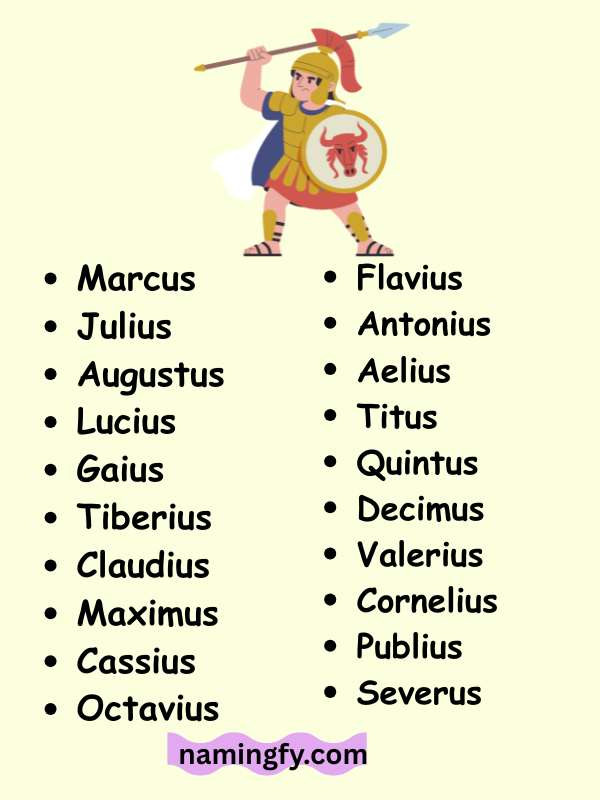
Some names appear again and again throughout Roman history because entire dynasties reused them.
Popular historical Roman names:
- Julius
- Augustus
- Antonius
- Brutus
- Cicero
- Pompey
- Sulla
- Cato
- Scipio
- Agrippa
These names appear in real historical records, inscriptions, and surviving Roman texts, making them ideal for historically accurate projects.
Roman Nicknames and Usernames
Roman-style usernames work well because they sound unique but are still easy to say and remember.
Roman nickname and username ideas:
- MaximusRex
- CaesarVibes
- IronLegionary
- SPQR_Marcus
- ColosseumKing
- LatinLegend
- ImperiumX
- CenturionOne
Short, punchy Roman words like “Rex,” “Lux,” and “Nox” work great as standalone gamer tags too.
Unique One-Word Roman Names
Sometimes one word says everything. Latin gives you strong single-word options with built-in meaning.
Unique one-word Roman names:
- Lux (light)
- Nox (night)
- Rex (king)
- Fortis (strong)
- Verus (true)
- Ferox (fierce)
- Ardens (burning)
- Celer (swift)
These are perfect for brand names, pet names, or minimalist character titles.
Themed Roman Names
Grouping names by theme makes it easier to pick names that match your project’s tone.
War-themed: Mars, Ferox, Bellator, Gladius
Wisdom-themed: Minerva, Sophus, Prudentius
Nature-themed: Silva, Flora, Aquila, Ursus
Royalty-themed: Rex, Regina, Imperator, Augustus
Pick a theme first, then narrow your list. This makes naming characters or projects much faster.
A–Z Roman Name List
Here’s a quick alphabetical list covering most letters for fast reference.
- A – Aurelius
- B – Brutus
- C – Claudius
- D – Decimus
- E – Emilia
- F – Flavius
- G – Gaius
- H – Hadrian
- I – Ignatius
- J – Julia
- L – Lucius
- M – Marcus
- N – Nero
- O – Octavia
- P – Publius
- Q – Quintus
- R – Rufus
- S – Servius
- T – Titus
- V – Valerius
This list works as a quick generator when you just need a starting letter.
Interesting Facts About Ancient Rome and Roman Names
Roman naming customs reveal a lot about daily life and social order.
- Only free Roman citizens used the full tria nomina system.
- Slaves usually had one name, often changed by their owner.
- Adopted sons added “-anus” to their birth family name.
- Women rarely had a personal praenomen at all.
- Emperors often added extra titles like “Augustus” or “Caesar” to their names.
- Some families reused the same praenomen for generations, causing confusion historians still deal with today.
These small details make Roman naming far more structured than most ancient cultures.
How to Create Your Own Roman Name
Building your own Roman name is simple once you understand the tria nomina structure explained earlier.
Follow these steps:
- Pick a praenomen from the short list of common first names.
- Choose or invent a nomen ending in “-ius” for a clan feel.
- Add a cognomen describing a trait, place, or achievement.
- Adjust endings to “-a” or “-ia” if creating a female name.
- Test it out loud. Roman names should sound rhythmic and strong.
For example: Start with Titus, add Cornelius, then add Ferox for “fierce.” You get Titus Cornelius Ferox, a name that instantly sounds historically authentic.
Frequently Asked Questions
What are the three parts of a Roman name?
A full Roman name has a praenomen (first name), nomen (clan name), and cognomen (family branch or nickname).
What do Roman name endings mean?
Male names usually end in “-us” or “-ius,” while female names end in “-a” or “-ia,” following Latin gender rules.
What are famous Roman emperor names?
Augustus, Nero, Trajan, and Hadrian are among the most famous Roman emperor names in history.
What’s a good Roman name for a girl?
Julia, Livia, and Claudia are popular, easy-to-pronounce Roman names for girls today.
Are Roman gladiator names different from citizen names?
Yes, gladiators often used fierce stage names like Spartacus or Flamma instead of their formal citizen names.
Can I use Roman names for fantasy characters?
Yes, Roman names work great in fantasy since they sound powerful and rarely need extra explanation.
Did all Roman women have three names?
No, most Roman women only had one name, usually the feminine form of their father’s family name.
Conclusion
Roman names carry real history in every syllable. From the tria nomina system to gladiator titles, each name tells a story about power, family, or fate.
Whether you’re naming a character, a pet, or your future child, Rome offers thousands of years of naming inspiration to pull from. For deeper historical reference, sources like Britannica’s Roman naming overview offer excellent additional context.

Emma is a passionate writer and name enthusiast with over 5 years of experience exploring the meanings, origins, and hidden stories behind names.












1 thought on “Ancient Roman Names Generator | Latin Lineage, Virtue & Imperial Names”