A great knight name should sound brave the moment you say it out loud. It should carry honor, steel, and a little bit of legend in every syllable.
This guide gives you hundreds of knight names for fantasy books, DnD characters, video games, and creative writing. You’ll also learn how real knights got their titles and how to build your own name from scratch.
A knight’s name is never just a label. It’s a small story on its own, hinting at where the character came from, what oath they swore, and what kind of battle they might have already survived.
Random Knight Names Generator
Random Knight Names Generator
Generate heroic and legendary knight names for fantasy stories, RPG characters, games, novels, and world-building projects.
Best Fantasy Knight Names
A fantasy knight name needs weight. It should sound like it belongs on a banner, a tomb, or a battlefield oath.
The best fantasy knight names mix a strong first name with a bold surname or epithet. Here are some top picks:
- Sir Aldric Thornshield
- Dame Elowen of Greycliff
- Sir Caelum Ironheart
- Ser Bastian Duskrider
- Lady Vaelith Stormcrown
- Sir Roderic Blackwood
- Dame Isolde Nightbrook
- Sir Tobias Dragonfell
- Ser Aveline Frostmere
- Sir Marcus Hollowgate
Each name here works because it’s easy to say and easy to picture. That’s the real test of a good fantasy knight name.
Cool Knight Name Ideas
Sometimes you don’t want “noble.” You want a name that just sounds cool when shouted across a tavern or a battle line.
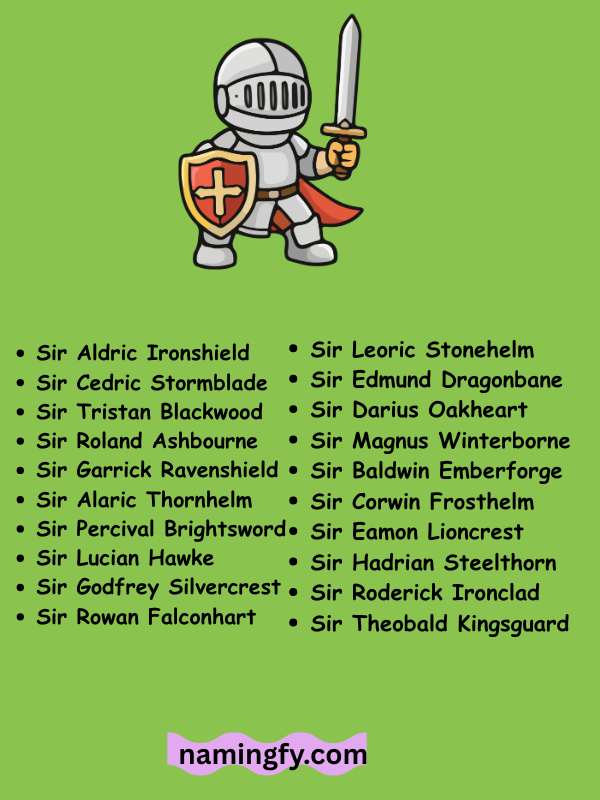
Cool knight names lean on sharp sounds and short punchy titles. Try these:
- Sir Kade Ashborn
- Ser Wraith of the Hollow
- Sir Dax Ironclad
- Lady Rhiannon Steelwind
- Sir Corin the Unbroken
- Ser Talon Blackspire
- Sir Ryker Duskblade
- Dame Sable Nightshard
- Sir Zane Grimhold
- Ser Kestrel Wolfsbane
These names work well for action-heavy stories, video game characters, or anyone who wants a knight with an edge.
Male Knight Names
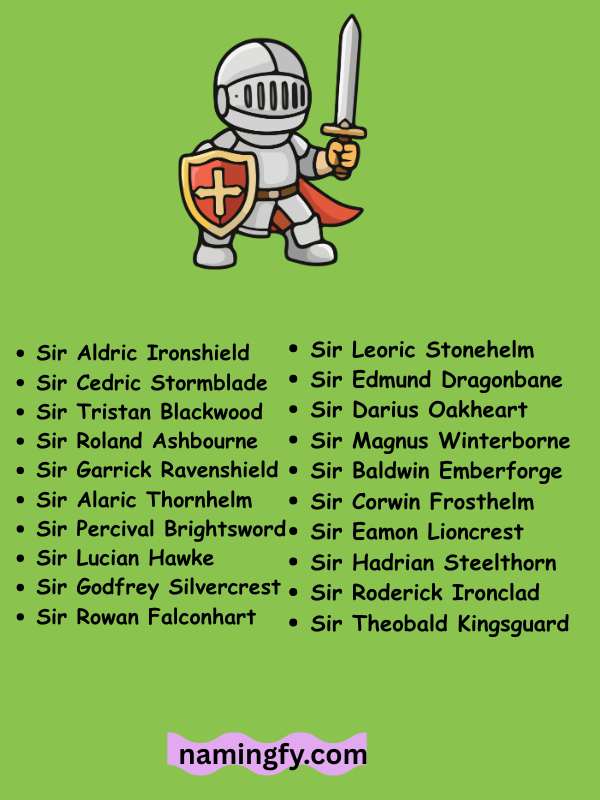
Male knight names usually pair a firm first name with a title like Sir or Ser. The sound should feel grounded and strong.
Here’s a solid list of male knight names for any fantasy setting:
- Sir Gareth Ashwood
- Sir Cedric Brightblade
- Ser Alaric Stonefist
- Sir Baldwin Hawthorne
- Sir Roland Fireheart
- Ser Percival Goldenfield
- Sir Godric Wolfsbane
- Sir Thane Ironhelm
- Ser Owen Silverlance
- Sir Marius Flintkeep
These names draw from Old English, Germanic, and Norman roots, which is exactly why they sound so authentic.
Historically, real male knights rarely had exotic names. Most were named after saints, kings, or family members, so names like Gareth, Cedric, and Roland strike a good balance between historical believability and fantasy flair.
Female Knight Names
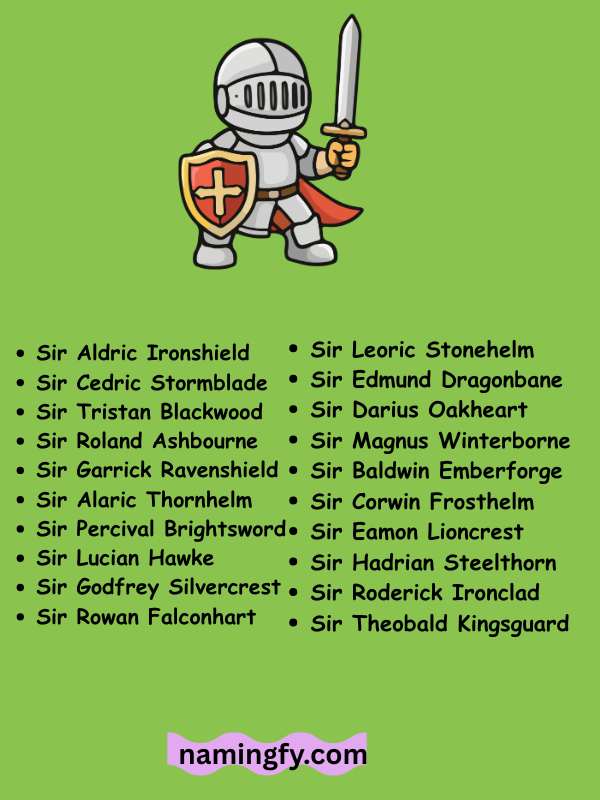
Female knight names carry the same strength as male ones, often paired with the title Dame instead of Sir.
Here are strong female knight names to use:
- Dame Rosalind of the White Rose
- Dame Elara Frostwind
- Dame Sabine Crownhollow
- Dame Isolde Rosewall
- Dame Wynne Ashthorn
- Dame Briar Stormcaller
- Dame Elowen Juniperhold
- Dame Averil Nightsong
- Dame Thea Goldshield
- Dame Rowena Whitehaven
Female knight names in fantasy often lean into nature words and softer endings, but they still sound tough and capable.
The title “Dame” has real historical roots. It was used in medieval England as the female equivalent of “Sir,” often given to women who held land, led households, or earned recognition through service.
Catchy Unisex Knight Name Ideas
Many modern fantasy worlds use gender-neutral titles like Ser instead of Sir or Dame. This works well for unisex knight names.
Here are catchy unisex options:
- Ser Quinn Ironvale
- Ser Alex Duskmere
- Ser River Blackthorn
- Ser Sage Stormhollow
- Ser Rowan Frostgate
- Ser Ash Nightwarden
- Ser Kai Steelbrook
- Ser Wren Hollowfield
- Ser Marlowe Oakenshield
- Ser Briar Ravensworth
Unisex knight names are great for tabletop games where the character’s gender is undefined or fluid.
The title “Ser” became popular largely through George R.R. Martin’s “A Song of Ice and Fire,” where it functions much like “Sir” but without tying itself to a specific gender.
Many modern game studios and tabletop systems have adopted this same convention, which makes “Ser” one of the most flexible and widely recognized unisex knight titles in fantasy today.
Unisex names are also handy for online multiplayer games, where players may not want to reveal a specific gender for their character. A name like “Ser Quinn Ironvale” works perfectly regardless of who’s behind the keyboard.
Mythical Knight Names
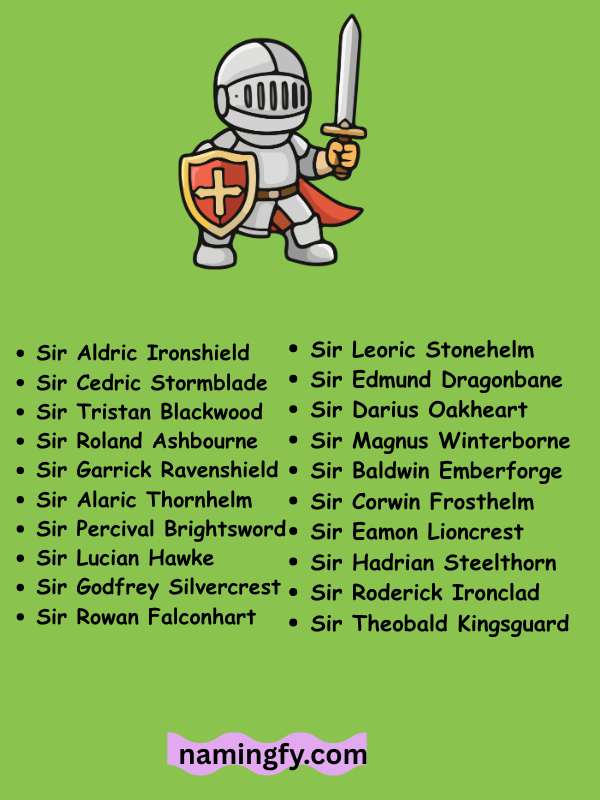
Mythical knight names pull from legend, folklore, and old gods. They feel bigger than life, like something out of an ancient saga.
Try these mythical knight names:
- Sir Aetherion the Skybound
- Dame Nyx Shadowveil
- Ser Solvane the Sunforged
- Sir Draumir Starcaller
- Lady Morrigana of the Ravens
- Sir Baelfyre Dragonsbane
- Ser Thessaly Moonward
- Sir Ector the Undying
- Dame Vespera Duskstar
- Sir Caradoc the World-Walker
These names fit stories with gods, prophecies, and legendary quests. They sound like they’ve already lived a thousand years.
Mythical names work best when paired with a bit of backstory. A name like “Sir Ector the Undying” hits much harder once you know he supposedly survived a battle that killed everyone else on the field.
Funny Knightly Names
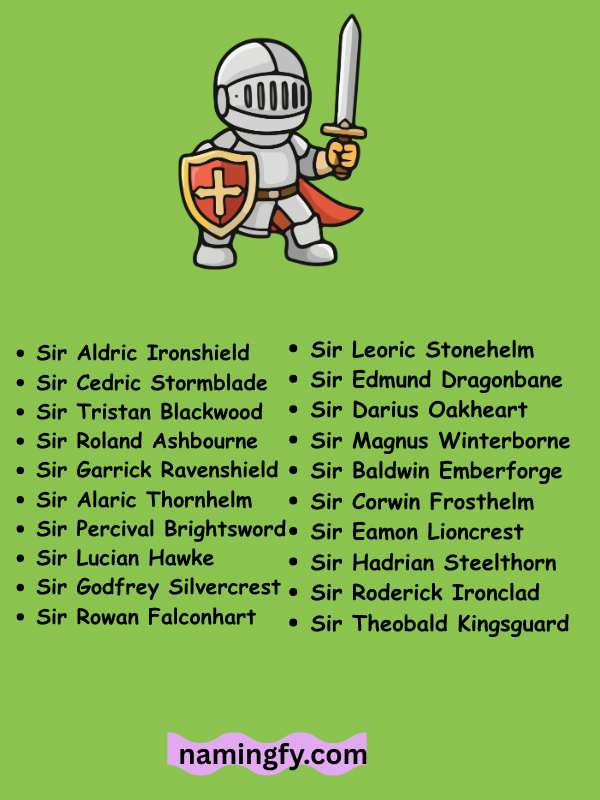
Not every story needs a serious tone. Funny knight names are great for comedy campaigns, parody stories, or lighthearted games.
Here are some funny knightly names to try:
- Sir Reginald the Slightly Late
- Ser Pudding of Lumpshire
- Sir Bumbleton the Clumsy
- Dame Gertrude Bignose
- Sir Wobblecup the Brave
- Ser Nogood of Nowhere
- Sir Snoreslot the Sleepy
- Dame Pickles Ironbottom
- Sir Grumblesworth the Grouchy
- Ser Toastface Thunderpants
These names work best in comedic tabletop sessions or parody fantasy writing where the tone is meant to be silly.
Funny knight names usually break the noble-title pattern on purpose. Instead of “the Bold” or “the Just,” you get “the Slightly Late” or “the Clumsy,” which instantly signals to the audience that this character isn’t meant to be taken too seriously.
Dark Knight Names
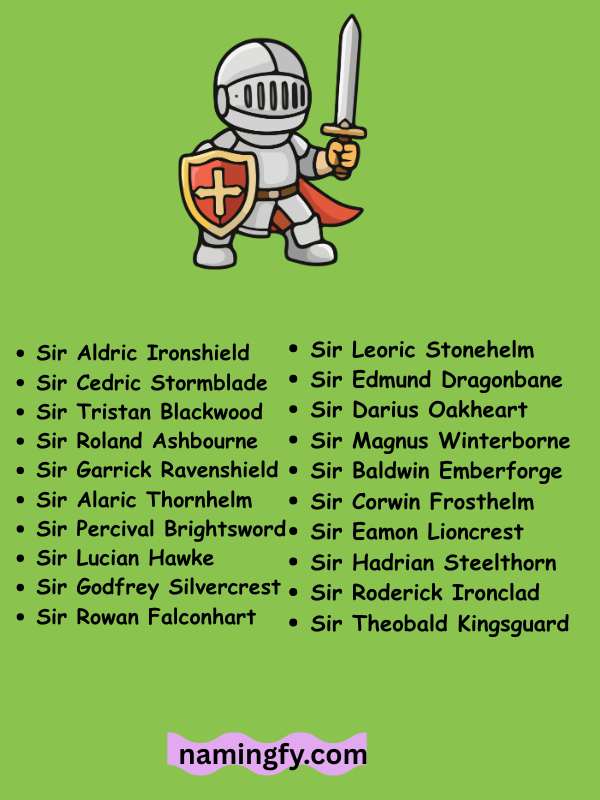
A dark knight name should feel heavy, cold, and a bit dangerous. This is about tone and mood only, not any comic book character.
Here are dark knight names for grim fantasy settings:
- Sir Malachar Grimhollow
- Dame Ravenna Blackthorn
- Ser Theodric Nightbrook
- Sir Vorn the Oathbroken
- Lady Serathine of Ash
- Sir Draven Coldmourne
- Ser Ulric Bloodgate
- Sir Kaelen the Forsaken
- Dame Morwenna Duskblight
- Sir Aldous Ironshroud
These names suit villains, fallen knights, or anti-heroes who serve dark causes.
Dark knight names usually replace bright virtue words like “Bright” or “Gold” with heavier ones like “Grim,” “Ash,” “Blood,” or “Hollow.” This small swap changes the entire tone of the name without changing its structure.
Knight Last Names
A strong last name gives a knight instant identity. Most knight surnames come from places, weapons, or personal traits, and each type sends a slightly different signal about the character wearing it.
| Surname Type | Example | Feel |
| Place-based | Ashford, Blackwood, Greycliff | Rooted, noble |
| Weapon-based | Ironblade, Steelbrook, Stormhammer | Martial, bold |
| Nature-based | Oakenshield, Ravensworth, Frostgate | Grounded, wild |
| Virtue-based | Trueheart, Fairwind, Brightvow | Honorable, pure |
More knight last names to pick from:
- Stonefist
- Hollowgate
- Duskrider
- Ironvale
- Nightbrook
- Frostmere
- Wolfsbane
- Brightblade
Mix and match any of these with a first name to build your own unique knight full name.
In real medieval history, surnames often developed the same way. A knight might be called “of Ashdown” because that’s the land he held, or “Longsword” because of a weapon he was famous for using in battle.
Traditional and Magical Knight Names
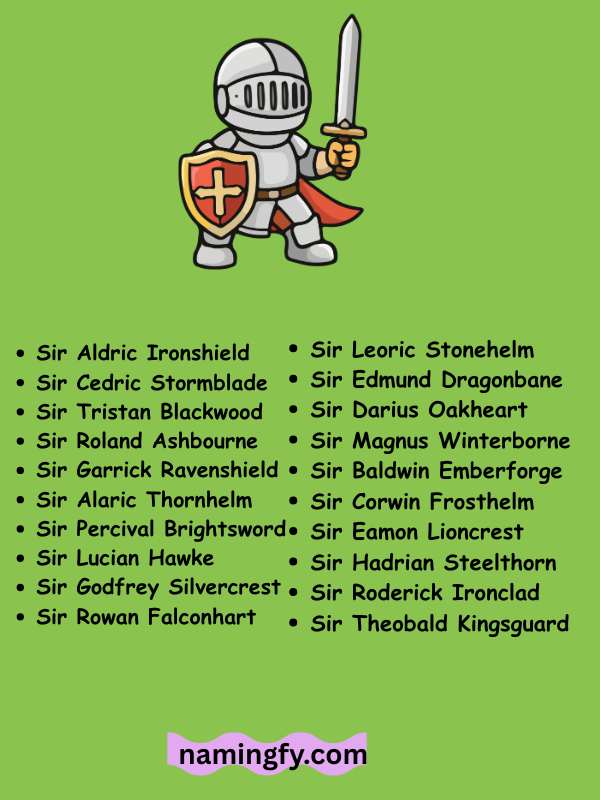
Traditional knight names come from real medieval naming patterns. Magical knight names add a fantasy twist with spellcraft or enchanted themes.
Traditional knight names:
- Sir William of Ashdown
- Sir Hugh de Warenne
- Sir Robert Fitzgilbert
- Sir Richard Longsword
- Sir Geoffrey de Clare
Magical knight names:
- Sir Runeheart the Spellbound
- Dame Lyra Moonweaver
- Ser Talvern the Enchanted
- Sir Orin Starforge
- Dame Seraphine Glimmerhold
Traditional names feel historically real, while magical names bring in wizardry, runes, and enchanted armor themes.
Traditional knight names are ideal for historical fiction, war dramas, or any story trying to feel grounded in real medieval life. They rarely use invented surnames, sticking instead to place names like “of Ashdown” or family names like “Fitzgilbert.”
Magical knight names, on the other hand, suit high-fantasy worlds where knights might carry enchanted swords, wear runic armor, or serve a magical order rather than a human king. Both styles can exist in the same story if you use them for different character types.
A great trick is to use traditional names for older, senior knights and magical names for younger characters touched by newer, stranger forms of power. This contrast can even become a plot point, showing how a world’s magic is changing across generations.
Powerful Knight Names and Their Meanings
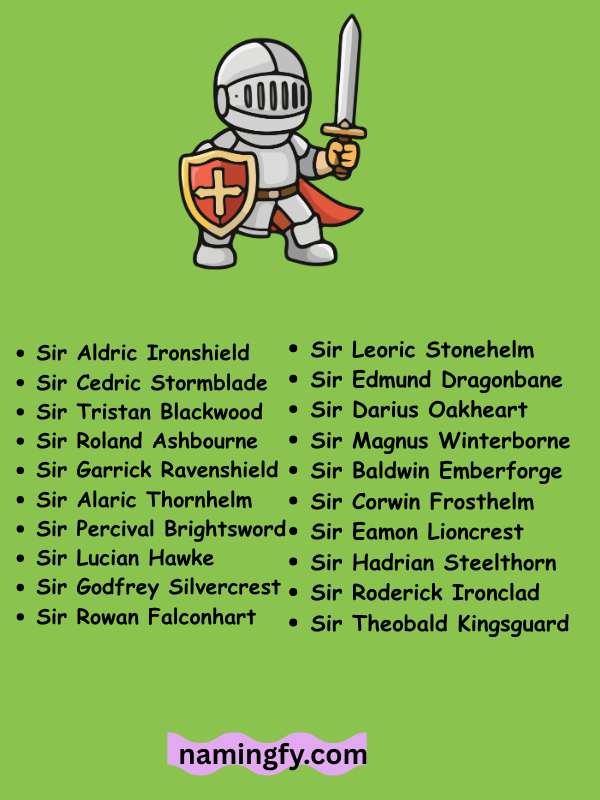
Some knight names carry meaning that adds real depth to a character. A name with a strong, fitting meaning can quietly tell readers who this knight is before the story even explains it. Here’s a quick reference table:
| Knight Name | Meaning | Best Used For |
| Sir Alaric the Bold | “Ruler of all” | Leaders, kings’ champions |
| Dame Isolde the Fair | “Ice ruler” or “fair one” | Noble, romantic characters |
| Sir Godric Ironheart | “God’s power” + strength | Holy warriors, paladins |
| Sir Roland the Valiant | “Famous land” | Legendary heroes |
| Dame Wynne the Just | “Fair, blessed” | Judges, honest rulers |
| Sir Baldwin Stormward | “Bold friend” | Loyal guardians |
| Sir Percival the Pure | “Pierce the valley” | Questing knights |
Meaning-based names give writers and players a shortcut to a character’s personality without extra explanation.
Many of these meanings come from real etymology. “Alaric,” for example, is a genuine Germanic name meaning “ruler of all,” originally carried by a Visigothic king. Using historically accurate meanings adds a layer of authenticity that sharp-eyed readers will notice and appreciate.
If you want a name with real depth, pick the meaning first, then find a name that matches it. A knight meant to be the moral compass of your story deserves a name meaning “just” or “true,” not something chosen just because it sounds cool.
Knight Names for DnD, Pathfinder, ESO, and WoW
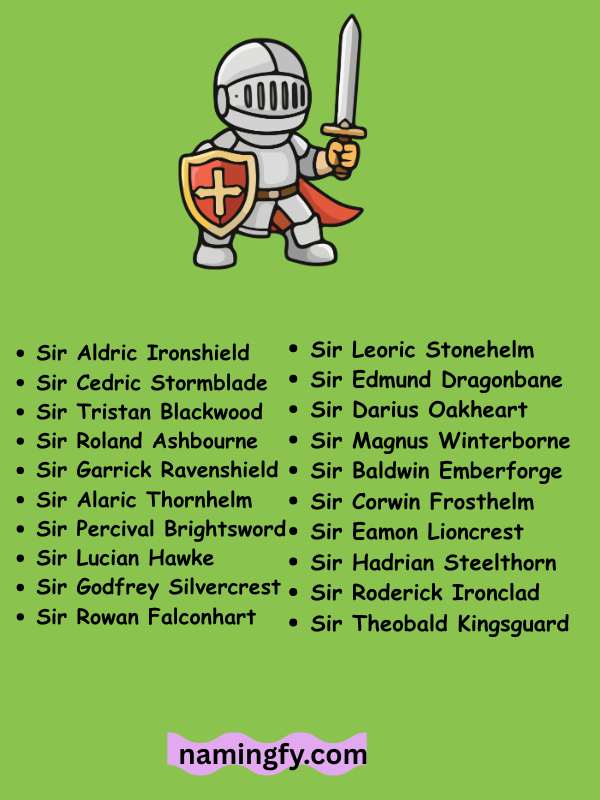
Game-specific knight names need to fit the tone of that world, since each game has its own lore, races, and naming conventions built up over years of development. Here’s what works best for each:
DnD and Pathfinder knight names:
- Sir Torin Dragonfell
- Ser Halric Stormvane
- Dame Elysia Brightward
- Sir Kaelor the Sworn
- Ser Bram Ironoath
Elder Scrolls Online (ESO) knight names:
- Sir Aldmeri Sunblade
- Dame Nord Frostguard
- Ser Redoran Stonewatch
- Sir Vael Dunmeri
- Dame Skyrend the Warden
World of Warcraft (WoW) knight names:
- Sir Thoradin Lightbringer
- Dame Alysra Silverwing
- Ser Grommash Ironfist
- Sir Kaltrian Duskblade
- Dame Farah Sunwarden
Each game world has its own naming flavor, so it helps to match the tone of the setting, whether that’s grim, holy, or high fantasy.
Real and Legendary Historical Knights (Middle Ages & the Round Table)
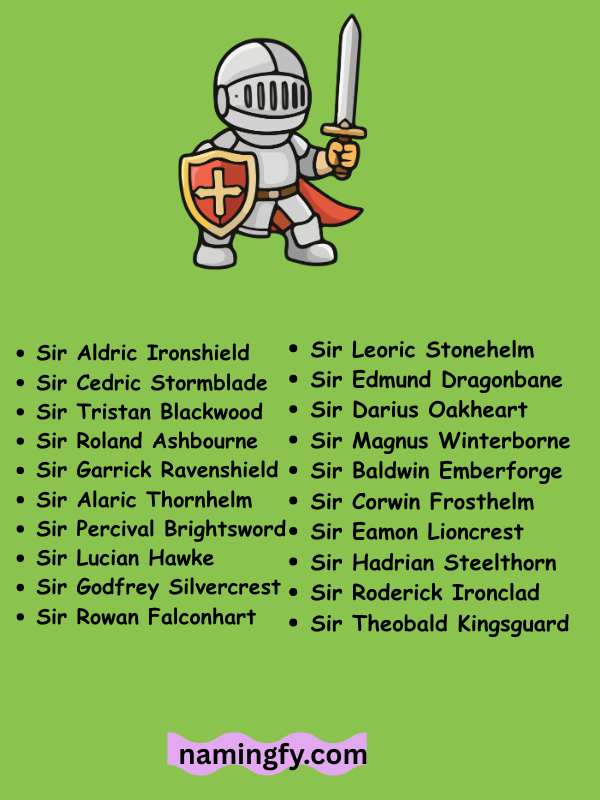
Many knight names we love today come from real medieval history and Arthurian legend blended together.
The Knights of the Round Table gave us some of the most iconic names in fiction:
- Sir Lancelot du Lac
- Sir Gawain
- Sir Galahad
- Sir Percival
- Sir Tristan
- Sir Bors
- Sir Kay
Real medieval knights, on the other hand, usually had far simpler names. William, Richard, Hugh, and Robert were common first names in the Middle Ages. Titles and epithets came later, often earned through battle deeds.
The Middle Ages also gave rise to knightly orders like the Knights Templar and Knights Hospitaller. These groups followed strict codes of chivalry, faith, and loyalty, which shaped how their members were named and remembered.
For readers who enjoy darker, older naming traditions rooted in myth and cosmic horror, this guide on Lovecraftian names shows how ancient dread and legend can shape a name just as much as chivalry does.
Famous Knights Throughout History
Beyond legend, real knights left their mark on history through actual deeds and battles.
Here are some famous historical knights worth knowing:
- William Marshal – Known as “the Greatest Knight” for his unmatched skill in tournaments and loyalty to four English kings.
- Hugh de Payens – The first Grand Master of the Knights Templar.
- Geoffroi de Charny – Author of a famous medieval book on chivalry.
- Edward, the Black Prince – A celebrated English military commander.
- Jean de Carrouges – Remembered for one of history’s last judicial duels.
- Sir Francis Drake – A knighted explorer and naval commander.
- El Cid (Rodrigo Díaz de Vivar) – A legendary Spanish knight and military leader.
These figures show how real chivalry, courage, and reputation shaped lasting knightly titles.
What makes these historical figures interesting is how differently each one earned their reputation. William Marshal rose through skill and loyalty rather than birthright, while Hugh de Payens built an entire religious-military order from nothing.
Studying real historical knights is a great way to add authenticity to fictional characters. Borrow their values, not just their names, and your knight will feel far more believable to readers who know their history.
Even a small nod to a real historical figure, like naming a mentor character after William Marshal, can add a satisfying layer of depth for readers who enjoy spotting historical references tucked into fantasy worlds.
Knight Nicknames and Usernames
Knight-themed nicknames work great for gaming usernames, social handles, or casual character names.
Try these knight nicknames and usernames:
- IronbladeKnight
- SirDuskrider
- TheHollowShield
- StormwardSer
- NightbrookVow
- AshenPaladin
- GrimhaltKnight
- FrostgateDame
- OathboundSir
- ThornshieldKnight
Short, punchy nicknames like these work well across gaming platforms and social profiles.
A good knight-themed username usually combines one strong noun with one strong adjective or action word, without any spaces. This keeps it easy to type and easy to search for on most gaming platforms.
Unique One-Word Knight Names
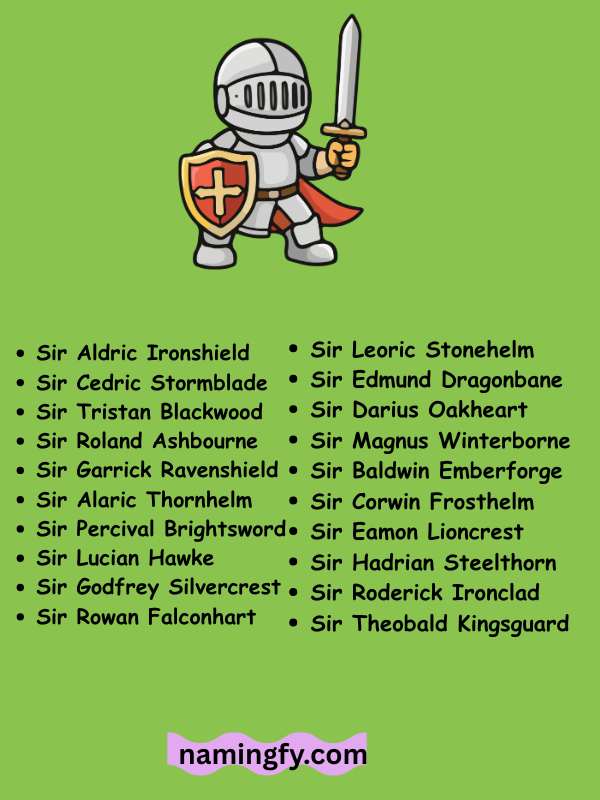
Sometimes one strong word says it all. One-word knight names work great for mysterious or minimalist characters.
- Ironvow
- Duskbane
- Stormforge
- Nightshard
- Ashguard
- Frostrend
- Wolfshield
- Thornvale
- Ravenmourne
- Skyward
These single-word names feel bold on their own and can double as a title, callsign, or last name.
One-word names work especially well for secretive characters, masked knights, or mercenaries who don’t share their full identity. A single strong word can carry just as much weight as a full title if it’s chosen carefully.
They’re also useful for branding a fictional order or guild, since a one-word name is easy to print on a banner, tattoo onto armor, or use as a chapter or guild title in a game.
Themed Knight Names (Elemental, Celestial, Nature-Inspired)
Themed knight names group naturally around one idea: fire, sky, forest, or storm. This makes it easy to build a whole order of knights with a shared identity.
Elemental knight names:
- Sir Emberfall
- Dame Frostveil
- Ser Stonebrand
- Sir Galewarden
Celestial knight names:
- Sir Starbound
- Dame Moonshard
- Ser Sunherald
- Sir Duskstar
Nature-inspired knight names:
- Dame Oakenheart
- Sir Willowshade
- Ser Thornwood
- Dame Ravensworth
Themed names are especially useful when naming a whole knightly order, since every member can share the same elemental or nature root.
Elemental knights work great in worlds with magic systems tied to the four classical elements, since the name itself signals which power the character wields before any spell is cast.
A–Z Knight Name List
Here’s a quick A to Z list of knight names to spark fresh ideas fast:
| Letter | Knight Name |
| A | Sir Alaric Stormbane |
| B | Dame Briony Ashwood |
| C | Sir Cedric Ironhelm |
| D | Ser Draven Nightbrook |
| E | Dame Elowen Frostgate |
| F | Sir Fenwick Thornshield |
| G | Sir Gareth Brightblade |
| H | Dame Hollis Ravenmourne |
| I | Ser Isolde Duskrider |
| J | Sir Jarek Stonefist |
| K | Dame Kaelith Sunward |
| L | Sir Lucan Wolfsbane |
| M | Ser Mira Steelbrook |
| N | Sir Norric Grimhollow |
| O | Dame Orlaith Oakenshield |
| P | Sir Percival Goldenfield |
| Q | Dame Quilla Frostmere |
| R | Sir Roland Ironvale |
| S | Ser Sable Nightshard |
| T | Sir Thane Blackwood |
| U | Dame Una Starcaller |
| V | Sir Vael Duskblade |
| W | Dame Wynne Ashthorn |
| X | Ser Xanther the Bold |
| Y | Sir Yorick Stormcrown |
| Z | Dame Zara Hollowgate |
This list works well when you need a fast name for any letter your story or character sheet requires.
An A–Z list is also a handy tool if you’re naming a whole cast of knights and want to avoid repeating the same first letter twice. Simply scan down the table and pick whichever letter still feels open in your story.
Feel free to mix first names from one row with surnames from another. There’s no rule that says a name has to stay exactly as listed here.
Interesting Facts About Knights
Knight history is full of surprising details that most people never learn in school. These facts also make excellent flavor text for game masters, novelists, or anyone building a believable medieval world.
- Knights followed a strict code of chivalry. Honor, bravery, loyalty, and protecting the weak were core values.
- Full plate armor was heavy but flexible. A complete suit weighed around 20–25 kg (45–55 lbs), yet let knights run, ride, and fight with ease.
- Jousting was medieval entertainment. Tournaments helped knights train and win fame, not just fight wars.
- Not all knights were born noble. Some earned knighthood purely through bravery on the battlefield.
- Squires trained for years before becoming knights. Training usually began in childhood and lasted until the late teens.
- “Sir” was only used for living knights. It was a title of respect, not just decoration.
These small facts add real historical flavor to any knight character or story.
- Chivalry had rules for tournaments too. Jousting matches followed formal codes of conduct, and cheating could cost a knight his reputation for life.
- Some knights fought on foot, not just on horseback. Heavy cavalry got the fame, but foot knights played a huge role in siege warfare.
- Coats of arms helped identify knights in battle. With helmets covering their faces, heraldic symbols on shields and banners were the only way to tell allies from enemies.
Weaving one or two of these details into your story or game session adds instant credibility, especially for readers who enjoy historically grounded fantasy.
How to Create Your Own Knight Name
Building your own knight name is simple once you break it into parts. Use the naming patterns from the sections above as your building blocks.
Follow these steps:
- Pick a title. Sir, Dame, Ser, or Lord/Lady depending on gender and setting.
- Choose a strong first name. Old English, Norse, or Latin-rooted names work best (see the Male and Female Knight Names sections above).
- Add a surname. Use a place, weapon, nature word, or virtue (check the Knight Last Names table above).
- Add an epithet if you want one. “The Bold,” “the Just,” or “the Unbroken” adds instant character.
- Match the tone to your world. Dark, mythical, funny, or traditional — pick the theme that fits your story.
A good knight name should be easy to say, easy to remember, and should hint at who the character really is.
For example, if you want a noble paladin, go back to the Male or Female Knight Names sections above and pick a strong, grounded first name like Cedric or Elowen. Then check the Knight Last Names table for a virtue-based surname like “Trueheart” or “Brightvow” to match the paladin’s holy purpose.
If instead you’re building a fallen knight or villain, revisit the Dark Knight Names section for surname inspiration like “Grimhollow” or “Nightbrook,” and consider an epithet from the Powerful Knight Names table that hints at a broken oath rather than an honored one.
This mix-and-match method means you never have to start from a blank page. Every section in this guide can act as a building block for your final, original knight name.
Choosing a Knightly Title: Sir, Ser, Dame, or Lady
The title in front of a knight’s name sets the tone before the reader even reaches the first name. Getting this small detail right makes a big difference in how believable your character feels.
| Title | Best For | Origin |
| Sir | Male knights, traditional or historical settings | Old English/Medieval English |
| Dame | Female knights, formal or noble settings | Medieval English |
| Ser | Gender-neutral knights, modern fantasy | Popularized by fantasy fiction |
| Lord/Lady | Knights who also hold land or noble rank | Feudal English nobility |
If your world sticks close to real medieval history, “Sir” and “Dame” are your safest choices. If you’re building an original fantasy world with its own rules, “Ser” gives you more flexibility, especially for characters whose gender isn’t specified or relevant to the story.
Some fantasy worlds also invent entirely new titles, like “Blade” or “Warden,” to separate their knightly orders from real-world history. This works well if you want your setting to feel distinct from typical medieval fantasy.
Whichever title you pick, stay consistent throughout your story. Switching between “Sir” and “Ser” for the same character without a clear reason can confuse readers and weaken the sense of a well-built world.
Frequently Asked Questions
What is a good knight name structure?
A good structure is Title + First Name + Surname, like Sir Cedric Ironhelm. You can add an epithet like “the Bold” for extra flavor.
What are strong male knight names?
Sir Gareth Ashwood, Sir Cedric Brightblade, and Sir Roland Fireheart are strong, classic examples.
What are good knight names for DnD?
Sir Torin Dragonfell and Ser Halric Stormvane both work well for DnD characters and campaigns.
What do knight titles like “Sir” and “Dame” mean?
“Sir” is the traditional English title for a male knight, while “Dame” is used for a female knight of equal honor.
Are these knight names free to use?
Yes, all names on this page are free to use for personal projects, games, and creative writing.
Where do most knight names come from?
Most come from Old English, Norse, Germanic, and Arthurian legend traditions.
Should a knight’s name match their personality?
Yes. A brave, honorable knight suits a name meaning “bold” or “just,” while a fallen knight suits darker, heavier-sounding names.
Conclusion
Choosing the right knight name gives your character instant honor and presence. Whether you want noble, dark, funny, or mythical, this list has a name for every kind of story.
A great knight name blends sound, meaning, and history into just a few words. It should feel strong when spoken aloud and hint at the kind of warrior standing behind the armor.
Use the naming formula above to build your own original knight title in minutes. Mix a title, a first name, a surname, and an optional epithet until the combination feels exactly right for your character.
A strong name is the first step toward a character readers and players will truly remember. For more on how real knighthood shaped these naming traditions, see this overview of medieval knighthood from Britannica

Emma is a passionate writer and name enthusiast with over 5 years of experience exploring the meanings, origins, and hidden stories behind names.









1 thought on “Knight Names Generator – Valiant & Chivalric Titles of Ancient Renown”